A lesson in metal fabrication

Early during the setup of the HR Taskforce, I met an entrepreneur over breakfast in Nairobi.
I asked him a simple question: What is your biggest challenge as an entrepreneur fabricating wheelbarrows?
His answer surprised me.
“Getting skilled labour. Welders, to be precise.”
I remember thinking, How can that be?
Growing up, I had always heard that Kenya did not have enough jobs. Unemployment was the problem. Youth were looking for opportunities. Yet here was a guy running a business in Nairobi telling me that his problem was that he could not find enough people to work for him.
I was genuinely shocked. I told him that I was about to work on a youth employment programme that would connect young people to employment opportunities.
“This sounds like a problem I have a solution to,” I thought. “Why don't you hire welders fresh from college and train them?”He looked at me and asked a very simple question.
“Who is going to pay for my time and the materials I will waste while training them?”
Good question.
My first thought was that perhaps he could just price the training cost into the products. Maybe reduce his margins a little.
He quickly rejected the idea. His biggest advantage in the market was his pricing. He manufactured wheelbarrows using recycled metal, and because of his production model, he could sell them cheaper than the market average.
That was his competitive advantage.
Asking him to absorb the cost of training inexperienced welders was effectively asking him to give up the very advantage that kept him competitive.
Then I thought, What if the factory was in Mombasa?
Maybe we could figure something out.
Well, he did a quick market survey and, within about a week, he was setting up a small factory in Mombasa.He ordered materials, found a trainer and started looking for welders straight from TVETs. And then I remembered something. GOYN had just concluded a welding training programme a few months before I joined.
How cool is that?
Not cool at all, apparently. As I got the list and started making calls, seven out of ten were unreachable. Seven!
I will come back to that in another learning note because there is a whole lesson there. Of the ones I managed to reach, none lived particularly close to the factory.
Another lesson waiting for me: distance matters.
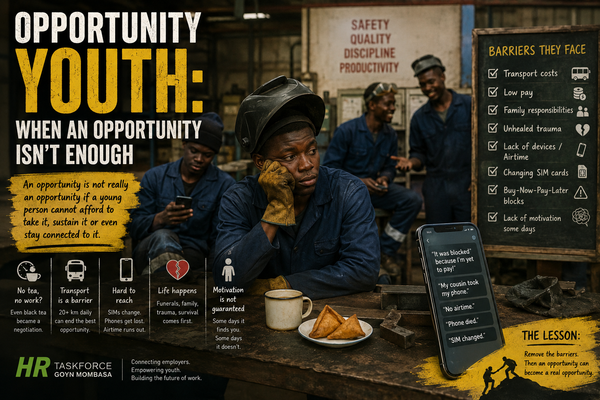
I would later learn much more about transport, accessibility and how young people make decisions about whether a job is actually worth travelling for. At that point, I also hadn't fully understood another problem.
Even with the employer making concessions, someone still had to pay for the apprenticeship.We needed to mobilise funds to subsidise the cost of training the young people while they were learning on the job.
I remember thinking:
If this works, we have a template for youth employment.
Hold that thought. Once we secured the funds, I had to find more welders.This time, I went to local TVETs. I was given a list of graduates from a TVET that was hardly one kilometre from my friend's factory.
Let's call it TVET A.
I started making calls. We asked 15 young people to come for interviews. All 15 agreed. On the interview day, 12 showed up and 9 were selected. Only 7showed up for work, so we started with seven. Seven became six in less than a week.
I needed more welders. At this point, let me introduce TVET B.
I needed another six young people so that we could get to our target of 12, knowing that some would inevitably drop out. And they did. But this time, the complaints were different.
The young people kept telling us that the factory was difficult to access. They were spending too much money on matatus and tuk-tuks just to get to work.I had not agreed to their choice of factory location, but this was not up to me to decide.
Save that story for another post.
Interestingly, my friend came back to me with another observation.Between the two groups, he preferred the graduates from TVET B.
He rated the TVET A graduates 2/10.
The TVET B graduates got 5/10.
That was another lesson.
Not all TVET graduates are the same. TVET A was a public institution with very limited resources. The training environment and equipment available to students mattered.
At the end of the three-month programme, only five of the young people were considered competent enough. Only three were considered good enough and offered full-time jobs.
And just when I thought we were beginning to understand youth employment, the business decided to teach me another lesson.
The business itself has to survive.
The company had orders to fulfil. In fact, they had managed to find an export market within East Africa.At first, this sounded like a blessing.
I would later learn that cash flow problems can turn a blessing into a curse very quickly.
The company had orders, but customers were not necessarily paying on time. Then, one night, our little factory was robbed.
Almost every piece of portable machinery was stolen.
Fortunately, they had just brought in a machine that could forge shovels. It was too heavy to steal, so it survived. But at that point, the thieves had stolen more than machines.
They had stolen part of the viability and future of the business.The wheelbarrow factory was now neck-deep in cash-flow problems.
Some customers had defaulted on payments. The business needed money to fulfil orders, but the machinery needed to produce those orders was gone.
And just like that, our beautiful youth employment template started disappearing in front of our eyes.
What started as one problem “We need skilled welders” had become a whole collection of problems fit for a movie script.
Finding young people.
Reaching them.
Getting them to the workplace.
Paying for apprenticeships.
Getting the right skills.
Managing dropouts.
Making the job worthwhile for the young person.
Making the apprenticeship affordable for the employer.
And, perhaps most importantly, keeping the employer's business alive.
Some of these problems we could influence.
Some we could subsidise. Some we could solve through partnerships.And some we simply couldn't solve.
Eventually, we went back to TVET A to explore whether they could buy what was left of the factory.And this led to yet another unexpected lesson.
We realised that the TVET was not really set up to run a commercial venture.They could train welders. They could provide equipment and facilities.
But running a business, managing customers, dealing with cash flow, fulfilling commercial orders and making a profit were a completely different game.
Looking back, I had entered this experience thinking I was going to solve a labour shortage. Instead, the experience taught me that youth employment is not just about young people needing jobs.
It is about the entire ecosystem around the job.
There has to be an employer.
The employer has to have demand.
The business has to make money.
The job has to make economic sense for the young person.
The young person has to have the right skills.
The workplace has to be accessible.
Someone has to absorb the cost of training.
And even when all those things come together, something can still go wrong. That was one of my first real lessons in building the HR Taskforce.
Sometimes, creating a job is not the hardest part. Keeping the job alive is.
And we were only getting started.