Skilling: I Thought the Problem Was Jobs

We just recently celebrated International Youth Skills Day 2026.
When we were setting up the HR Taskforce in 2024, I thought my only problem was to find enough jobs for skilled youth. It turns out, I was wrong.
Remember my wheelbarrow factory story, where welders from TVET A were rated 2/10? Well, we decided to pursue that problem. I spoke to the board at TVET A. They seemed to understand the root of the problem.
Funding.
Why funding? Well, everything has a cost, right?
This was a publicly funded institution. They had little or no budget to retain good lecturers, let alone buy machines, pay for electricity and buy enough materials for students to practice.
This means that some welders leave training with very little practical experience. The internship or apprenticeship program in the middle of their learning was partly supposed to address that, right?
Well, here is a welder who is probably not yet capable of welding two pieces of metal together properly. We unleash him to industry and hope that he learns on the job.
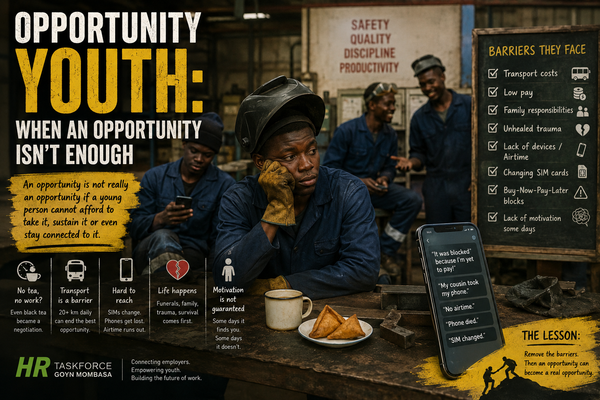
Some do. Others don't. Let's talk about the "others." They might lack the grit, the motivation or even the bus fare to keep going. We also assume that the master craftsman can teach. More about that in a future post.
Anyway, they graduate half-baked. Some will choose to fake it till they make it.
Welcome to the world of partially welded, mediocre designed and dangerous pieces of metal we live around as doors, windows, beds and other contraptions. If you have ever seen a door that looks like a wild animal trap in disguise, now you know who might have made it.
At this point, I need to make a disclaimer.
There are many more TVET As in Kenya, and probably around the world. This is not about blaming one institution. It is about the circumstances surrounding how young people are trained.
Let's move to TVET B. What makes their welders 5/10? Well, funding for starters. These guys were better funded. They had well-trained lecturers and better facilities.
Here is what surprised me.
Both TVET A and TVET B were government funded.
TVET B was well funded by the National Government, (underline the word Well-Funded) directly under the ministry. It was well organized and select students based on their grades.
TVET A, on the other hand, was funded by the county government through a capitation system. Let us just say the funds were never enough. TVET A struggles hiring and retaining teachers, facilities and resources.
Now think about this. When you give a good student a good learning environment, they can thrive, right? How about when you give a student who is already struggling a bad learning environment?
I am not blaming TVET A. I am looking at the circumstances.
And this is where I was introduced to another concept that would completely change how I thought about youth employment:
At this point, let me introduce you to Opportunity Youth (OYs)
Young people who are not in employment, education or training (NEET).
I remember thinking, how different can opportunity youth really be?
Well... Let's just say I am still learning. Painful. Humbling. Interesting Lessons.