When Youth Employment Meets a Bad Business Model

Our wheelbarrow factory was bustling with activity. The proprietor had a number.
10 wheelbarrows per hour.
Our apprentices were doing 3 to 4 at that time. The good news was that the wheelbarrows were now available at most hardware stores.
Remember, this series was partly about what worked in youth recruitment.
Hold on to the thought of what did not work. The location was off. But before we get there, let me introduce you to gypsum cornices. I also had no idea what they were when I first heard.
This was our second product.
Affordable housing projects were at their peak, so there was demand for wheelbarrows and potentially an opportunity to supply gypsum cornices too.
Based on the learnings from the earlier cohort of Wadzomba, we approached this slightly differently.We had a hypothesis:
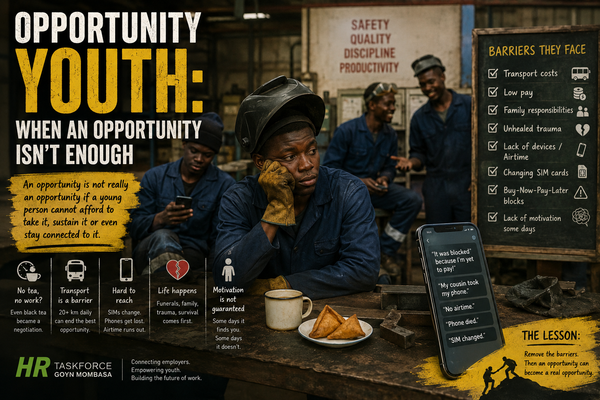
If opportunity youth are mentored, maybe they won't even ask for ten o'clock tea.
Our now cash-strapped wheelbarrow factory was about to test that hypothesis. Here is what we did. This time, we did not struggle to find candidates.
We took referrals from case managers within the mentorship programme at Swahilipot Hub Foundation. Lots of respect for one Mr. Mmbetsa Ngome (Omar). He was supervising case managers in an area close to our soon-to-be gypsum factory.
He was instrumental in identifying which opportunity youth had what it took to succeed.Here is a lesson I wouldn't want to forget.
When going through the list of Swahilipot mentees to call, I assumed the ones with no secondary school education would be the most suitable for this low-skilled, very manual, hands-on work.
I was surprised.The less educated they were, the harder they were to reach.This is something that needs to be studied.
My hypothesis is that they hardly receive calls for opportunities, so they have given up. Some work odd jobs and are therefore away from their phones during the day.
I remember one of them returned my call at 1 a.m.Anyway, I ended up reaching those who were reachable.We called about 19 for interviews.
Looking back, I feel some did not make it because they lacked bus fare.Twelve were selected.Ten showed up to start. Not bad compared to the previous cohort.And these guys were committed.
They attended every day. They did all they could to learn. So far, so good.
Then came the orders. Or rather...The orders never came.The affordable housing projects did not bring the business we expected. Our youthful team was idle most of the time. But they kept going to work.
Until eventually, it became difficult for some to continue working without pay. Some had to quit because they could no longer see any light at the end of the tunnel.
What began as an attempt to get youth recruitment right ended up becoming a not-so-good business case for this mini factory. Many months later, the factory folded.
And our super-motivated opportunity youth were jobless once more. Painful. But there was another lesson.
You can get youth recruitment right and still fail at youth employment.
Why? Because the business itself has to work. When setting up a business, location is always key.
For a wheelbarrow factory located on the outskirts of Nairobi, picking a location in Mombasa required some serious thinking. This brings up another aspect of entrepreneurship that increases the risk of failure.
There are very few services that can help a bootstrapping entrepreneur answer a simple question:
Where should I locate my factory?
Kenya Industrial Estates was designed to support small industries like these. County government information desks could also potentially play a role.
Maybe these services existed. Maybe our heroic entrepreneur just didn't try hard enough. Or maybe they did not function the way they were designed to. I'll let you, the reader, be the judge.
The proprietor looked at Changamwe, Mtwapa and Likoni. He settled for Likoni. My problem with Likoni and Mtwapa was the proximity to the island.Wheelbarrows are heavy.That requires a heavy-duty truck.
The owner had one. Just one. Remember that song:
"If I could be in two places at the same time..."
Well, the truck was splitting time between Nairobi and Mombasa.
Challenge 1: Logistics
Moving in and out of Likoni required expensive ferry crossings.At that time, the Dongo Kundu bypass was not open to heavy commercial vehicles.
Apart from the fuel cost of getting the truck from Nairobi, the driver was unfamiliar with the territory.At the ferry, it was either the police, ferry security or county askaris stopping the truck. Let's just say compliance came at a cost. Call me for the insider scoop.
Challenge 2: Manpower
Even with the good intention to hire youth, the factory had a number. Ten (10) wheelbarrows per hour. If you don't hit the number, expenses start coming in faster than income.
The factory needed experienced hires.Those were in short supply in that corner of Likoni. With a housing incentive, perhaps the owner could have convinced experienced workers to settle there. But that required capital.
Challenge 3: The business model
There was demand for wheelbarrows. But demand came at a cost. The factory had to produce hundreds of wheelbarrows using its own cash flow and then wait to be paid.
When payments were slow, or did not come, they should have pivoted to local customers who paid cash.
They didn't. That was one of their biggest downfalls.The cornices idea did not work either after the expected orders failed to come in. There were other factors.
Lack of proper systems.
Lack of supervision.
And the sheer belief of our model entrepreneur that he was Superman.
He could do anything. And everything.
He should have delegated more.
If you watched the movie The Perfect Storm, the factory met a similar fate to the boat.
It was a perfect storm of wrong choices and more wrong choices. Somewhere in all of this, we discovered something important; We had started with a simple question:
How do we create jobs for young people?
But the answer turned out to be much more complicated.
You need skills.
You need recruitment.
You need mentorship.
You need transport.
You need communication.
You need employers who can actually train.
And most importantly, you need a business model that works.
Because even when you are solving youth employment...
the business creating the employment has to survive.